Pilot program / troubleshooting intelligence

SPARK

A category-defining AI-assisted troubleshooting platform for complex industrial environments. SPARK is the action-oriented companion to REFLEX, turning anomaly evidence, engineering documents, schematics, and procedures into auditable diagnostic guidance without surrendering operator authority.

Evidence-bound
Every insight traces to verified source material.
Validator-first
Deterministic safety gates before operator display.
Air-gapped
Runs fully disconnected, with no cloud or outbound data flow.
SPARK_DIAGNOSTICS
SYS
HYD
ELEC
RCA
Evidence-bound troubleshooting
Documents / schematics / incidents
Validated
Bound
Source evidence
Graph
Engineering topology
Local
Deployment posture
Evidence
Bound
Topology
Mapped
Output
Gated
Operational problem

Industrial troubleshooting breaks when evidence, drawings, and decisions separate.

When an anomaly appears offshore or in a remote facility, teams have to reconcile live symptoms, old document revisions, dense schematics, maintenance history, and safety procedures under pressure. Generic AI can sound fluent while losing provenance, missing topology, or crossing authority boundaries.

System view

SPARK is built for accountable investigation, not generic chat.

  • Bind every recommendation to exact source documents, revisions, pages, regions, and incident evidence.
  • Parse and reconstruct schematics into a reviewed semantic graph of verified topology, kept separate from a candidate hypergraph of unresolved connections and conflicting evidence.
  • Reconstruct complex schematics into navigable topology across electrical, hydraulic, and P&ID drawings.
  • Validate outputs against deterministic safety and provenance rules before they reach the operator.

How SPARK works.

SPARK combines evidence-bound retrieval, dual-layer knowledge governance, schematic intelligence, and validator-first safety into a field-ready troubleshooting platform.

01

Evidence-bound intelligence

SPARK does not ask operators to trust unsupported text. Every answer traces back to verified engineering documentation and is cryptographically bound to its source evidence.

02

Dual-layer schematic knowledge

Engineering schematics are parsed and reconstructed into two distinct graph structures: a reviewed semantic graph of verified connections, components, and topology, and a quarantined candidate hypergraph of unresolved hypotheses, conflicting interpretations, and junction candidates. Nothing moves from the candidate hypergraph to the reviewed semantic graph without deterministic validation and human review.

03

Schematic intelligence

Drawings are extracted at the vector level and reconstructed stroke-by-stroke — resolving crossings, junctions, and signal paths into structured, navigable topology that operators can inspect component by component.

04

Validator-first safety

Before output reaches the operator, an 18-rule deterministic validation matrix checks provenance, evidence dependency, contradiction detection, revision integrity, and authority boundaries. This isn't prompt-level guardrails — it's a mathematical gate.

Core capabilities and security posture.

SPARK combines rigorous troubleshooting with an operator-controlled deployment model built for fully disconnected environments.

Document intelligenceManuals, schematics, procedures, and reference materials are ingested through vector-accurate extraction into immutable, revision-tracked knowledge. Hybrid dense and sparse retrieval surfaces the right document region — not just keyword matches — so SPARK can cite the exact source behind any claim.
Diagnostic investigationSymptoms, affected subsystems, prior cases, topology, and operator observations are organized into evidence-ranked hypotheses and next-best checks.
REFLEX handoffWhen REFLEX detects and seals an anomaly, SPARK receives the evidence package and turns detection context into an operator-ready investigation path.
Field deploymentiPad work surface interfaced wirelessly to a local van-server. SPARK retains full capability while completely disconnected from the internet; optional synchronization occurs only when connectivity and operator policy allow.
Air-gapped securityWith the diagnostic pipeline disconnected, there are no cloud API calls, outbound data flows, or third-party servers in the loop. The pipeline has no internet-facing attack surface, and a cloud-side breach cannot expose data that never touches a cloud.
Data sovereigntyEngineering schematics, maintenance history, operational evidence, and diagnostic outputs remain inside the operator-controlled environment. No vendor cloud sees the operator's engineering IP.
USA-produced AI modelSPARK ships with a locally deployed Gemma 4 model produced by Google, a United States company. Its US-origin supply chain supports transparency and procurement review where domestic AI technology is required, while all inference remains on operator-controlled hardware.
Primary usersROV technicians, field engineers, maintenance teams, reliability engineers, supervisors, and technical authorities responsible for complex assets.
Best fitIndustrial systems where faults cross electrical, hydraulic, control, sensor, procedural, and documentation boundaries.
InputsREFLEX evidence bundles, engineering schematics, manuals, procedures, maintenance history, incident notes, and approved reference material.
OutputsEvidence summaries, topology-backed investigation paths, ranked hypotheses, test suggestions, contradiction flags, escalation notes, and auditable case records.
Safety and governance

SPARK advises inside a constrained authority envelope.

SPARK is built by people who understand safety-critical operations. It can investigate, cite evidence, explain uncertainty, and recommend checks, but it is designed to prohibit control commands, setpoint changes, safety bypasses, or alarm suppression.

  • Round-trip verification continuously tests the knowledge graphs for instability — detecting and flagging contradictions, stale revisions, and unsupported topology before they can influence operator guidance.
  • Human review remains the path from candidate hypothesis to authoritative engineering knowledge.
  • Audit trails preserve source evidence, document revision, operator context, and response provenance.
  • Low-evidence, contradictory, or out-of-authority requests can trigger clarification, escalation, or refusal.

SPARK screenshots.

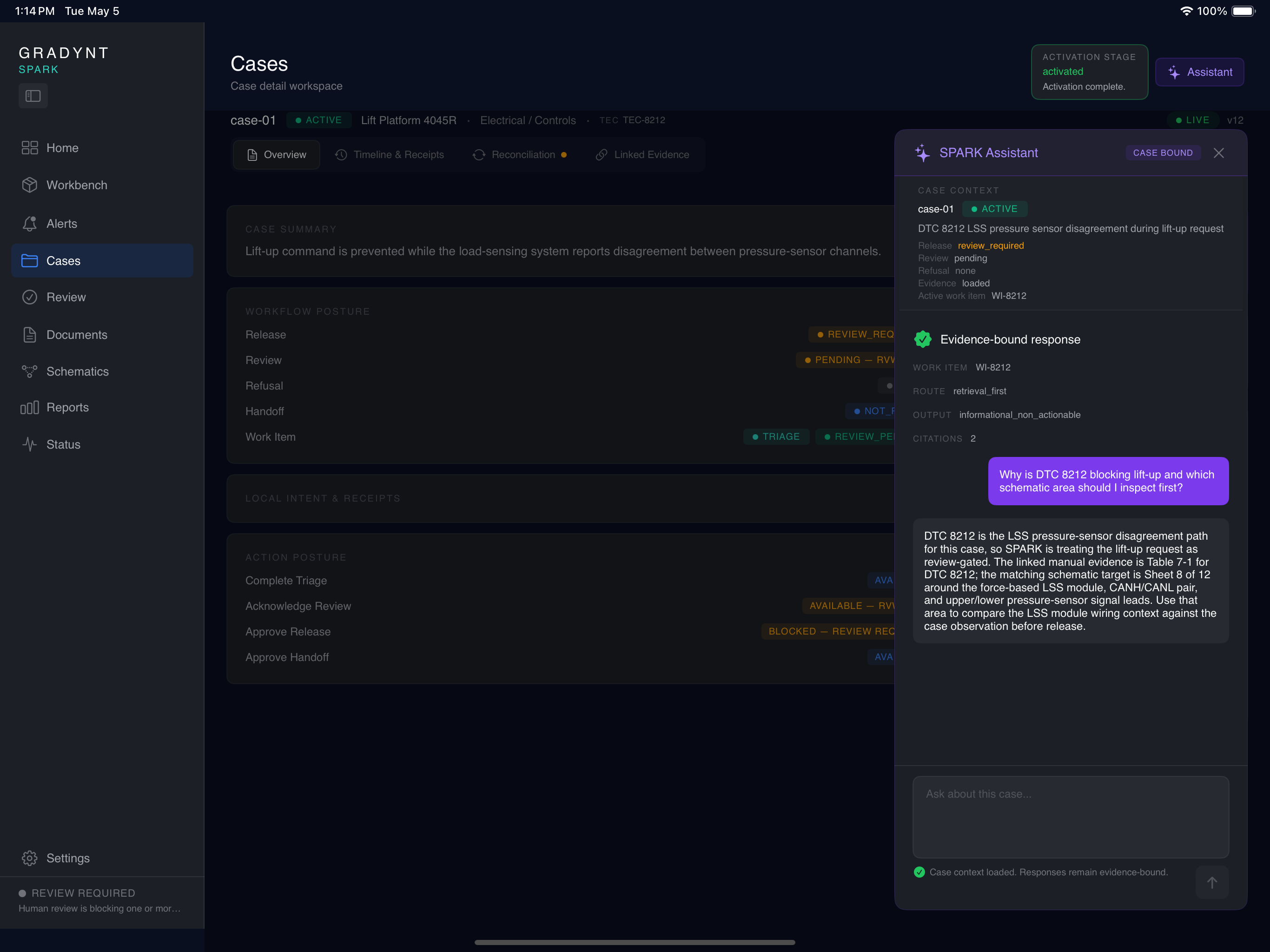
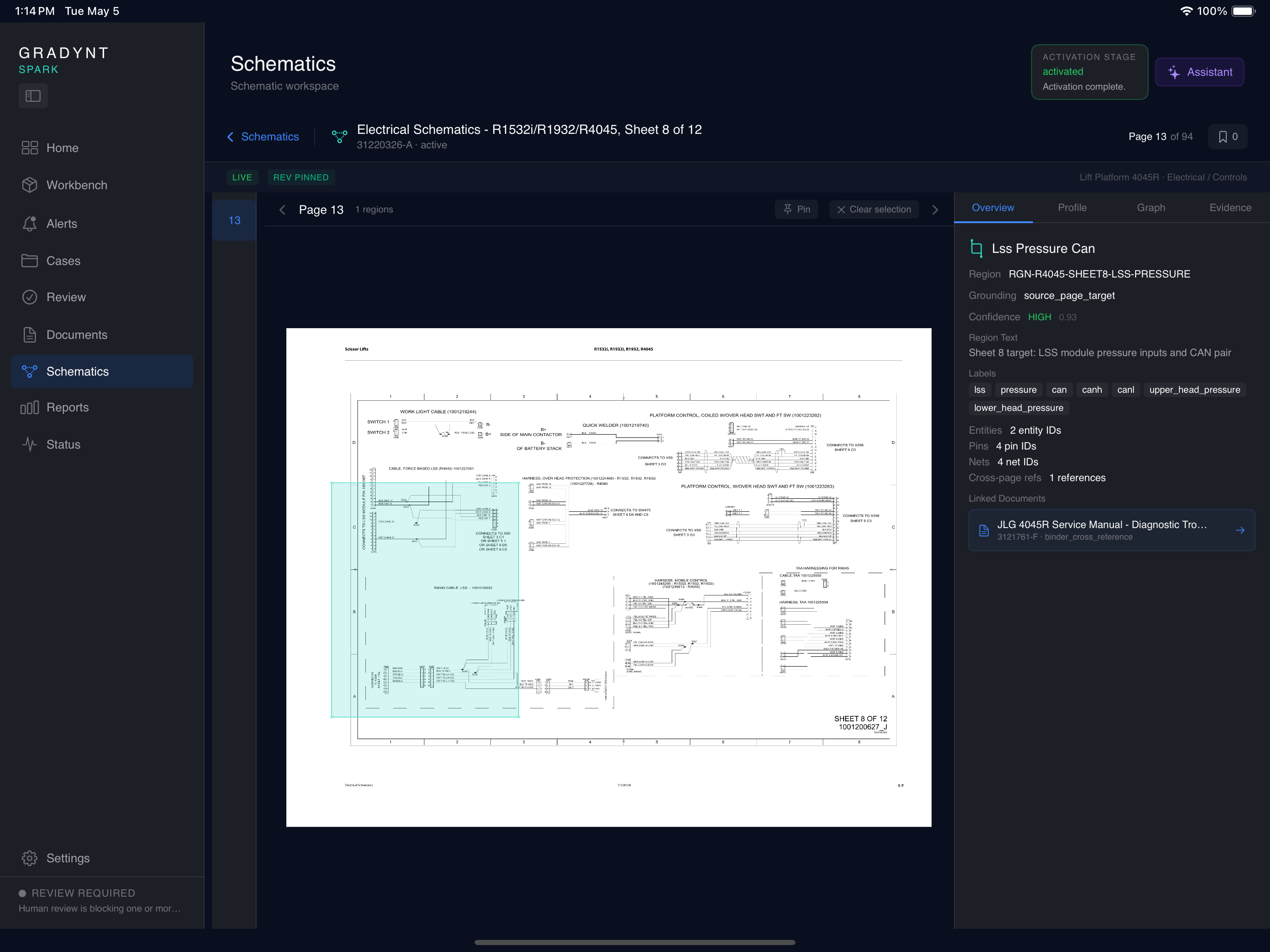
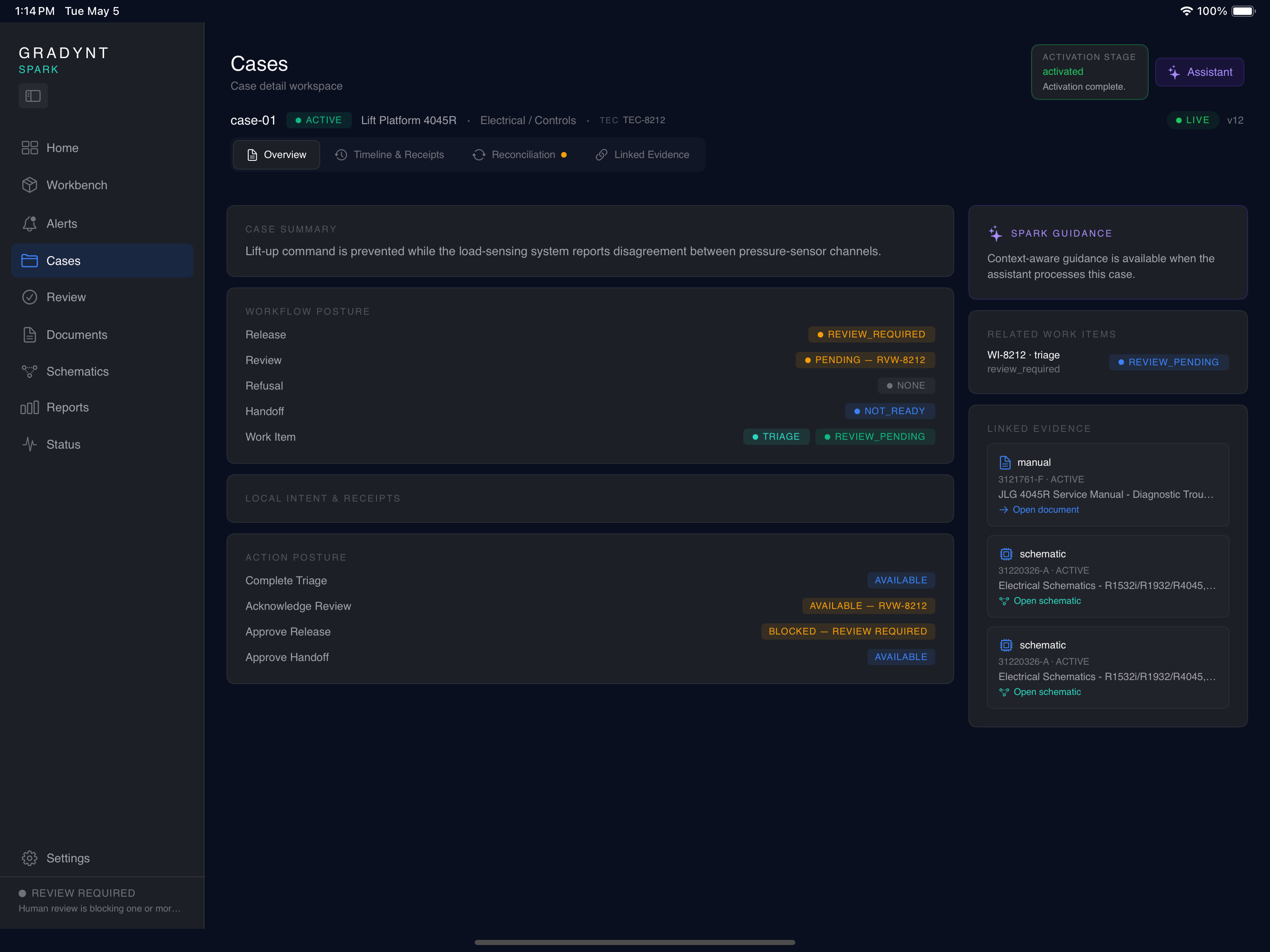
Representative views from an early alpha build of the SPARK operator workspace: case intake, evidence review, assisted troubleshooting, and schematic-focused investigation. Interface and workflows are subject to change as development continues.
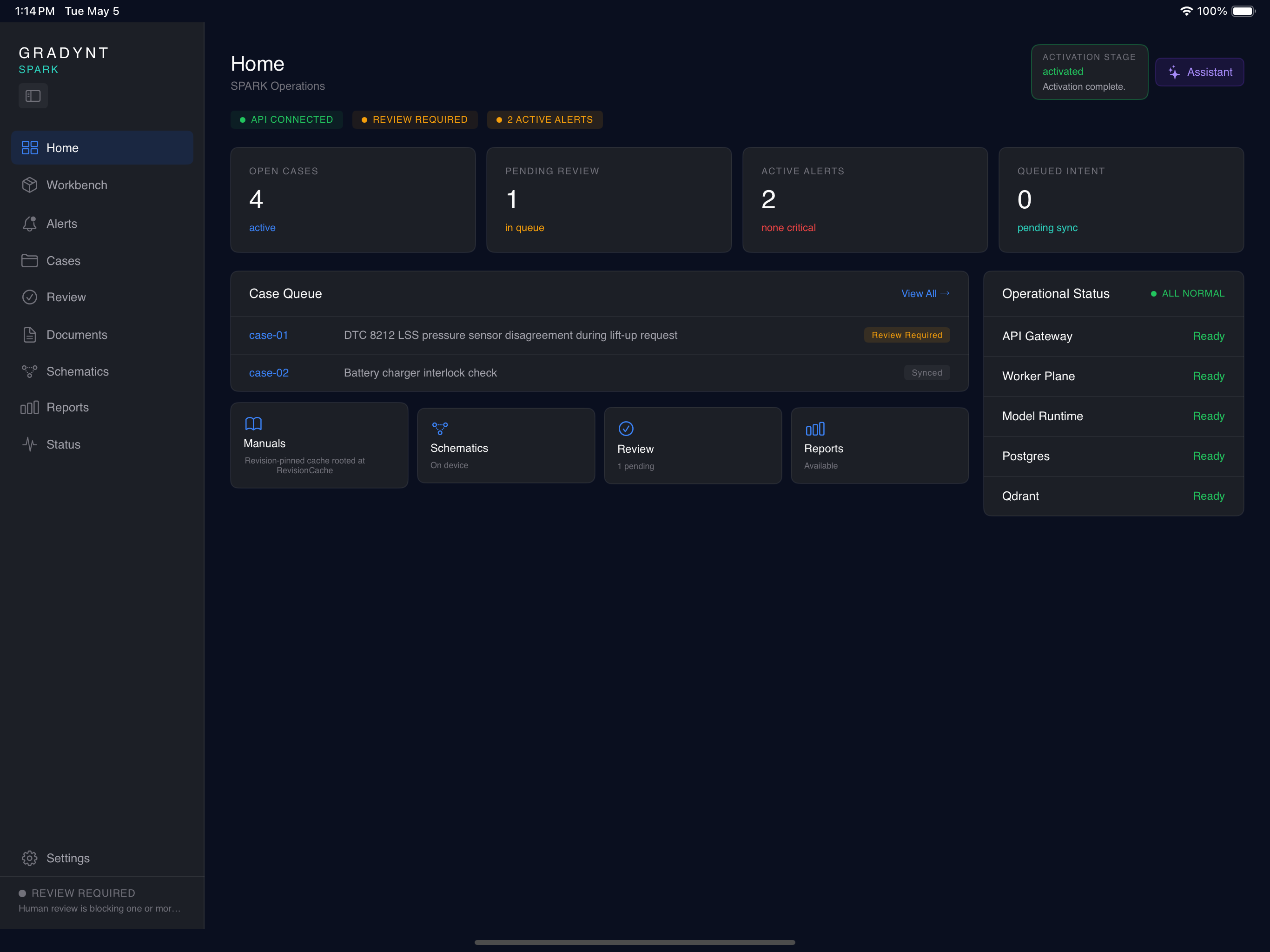
SPARK home screenshot
SPARK case detail screenshot
SPARK assistant screenshot
SPARK schematic target screenshot
Q3 pilot discussions open

Brief SPARK against a real anomaly-to-resolution workflow.

Q3 briefings are now open for Q4 pilot rollout. Bring a representative REFLEX incident, schematic set, document revision history, and the troubleshooting procedure your team relies on when the asset is offline.

Request SPARK Briefing